
Nothing to Fear but Fear Itself
 |
 |
Recently I called Maggie, and she didn’t show up. I was outside at the farm, working on clearing the muck-infused ice from a gate. The Border collies were out with me, behind the barn. No matter what I’m doing, I never let them out of sight; we live close to a road and even though the dogs are trained to stay off of it, they are dogs, not machines. I’m well aware that it just takes one second for trouble to turn into tragedy. In addition, let’s face it, I tend to be on the neurotic cautious end of the continuum.
“Maggie! Maggie Maggie!” I called again. Nothing.
And there it was. That feeling. That moment when your stomach drops like a plane hitting an air pocket. Fear, in all its physical glory.
I thought of this moment when several blog readers asked if I’d address the topic of fear. Of course, they were asking about fear in dogs, not their owners, but fear is an equal opportunity emotion, and it plays a huge role in the lives of the animals at both ends of the leash. It’s not always easy to deal with. Trying to talk a dog out of being afraid of a hot air balloon–or thunder, or an unfamiliar dog–is as effective as telling a person not to be afraid of the needle approaching their face at the dentist office. (What? Just me?)
Fear in dogs is also a hot topic right now, given the widespread coverage of the study by Biagio D’Aniello and colleagues that Dogs Really Can Smell Your Fear. (See PubMed for the abstract.).
The authors found that the scent of sweat, from men who had been exposed to scary videos, caused dogs to look at their owners more, to display “stressful behaviors”, and to have increased heart rates. Dogs smelling the sweat of men watching happy videos looked at their owners less and were more likely to approach strangers. (There was also a control with no sweat inserted into the scent dispenser.)
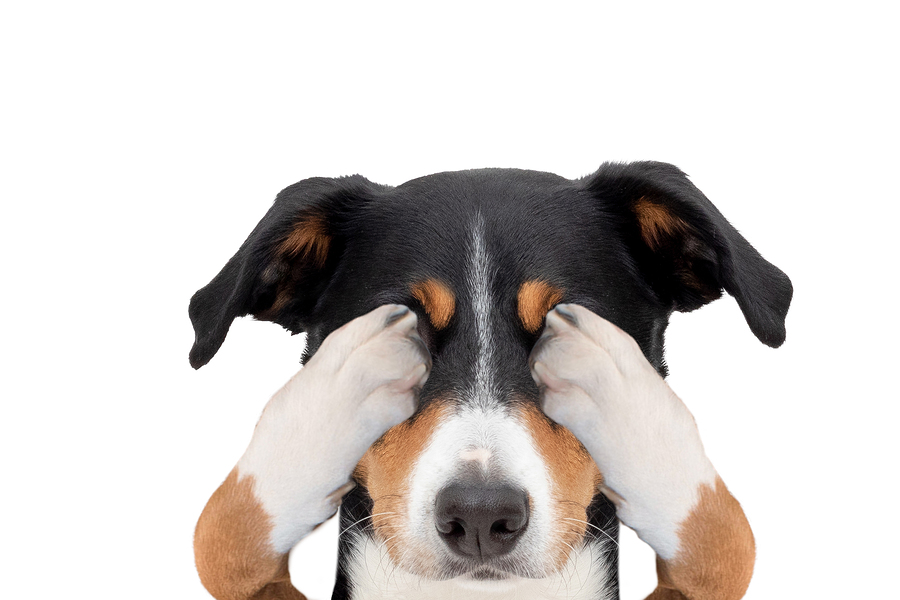
Of course this is just one study and needs to be replicated, but it passes the smell test (sorry), given what we know about the contagion of emotions in mammals. Not to mention the olfactory ability of dogs. If you’ve ever had a fearful dog, it’s also discouraging, because OF COURSE we believe that we might make our dogs worse if we are nervous ourselves. (Yeah, I was sort of yelling.) I can’t tell you how many of my clients have said “I know I shouldn’t get nervous when my dog sees ___ (fill in the blank), but I do, and I feel so guilty”. And yet, if the dog in the photo below is your dog, the words “don’t get nervous when you see another dog” aren’t particularly helpful.

(By the way, this dog is labeled “angry” by the stock photo site. I’d label the dog absolutely terrified.)
Okay then, what do we do? Here are a few ideas; please add your own from your own experience.
MANAGE: Management is a perfectly good solution to many fear-based problems. Teaching the dog who is afraid of visitors to run into a “safe space” is not a failure, it’s a smart strategy. Yes, of course, it’s still important to do what you can do treat the problem at its core, but good management is usually part of any good treatment plan. Of course, you can’t control when a hot air balloon appears over head, but you can put your dogs away when visitors come, or walk down a street where you can avoid unfamiliar dogs, or at least know where they are. And, hey . . . If management is as far as you can get, that’s okay too. Most importantly, know that if you have a plan both you and your dog will be less nervous. Rather than thinking “Oh No!” when a visitor comes, you’ll be busy happily clapping your dog into her crate in the back room.
TEACH AN INCOMPATIBLE RESPONSE: It’s hard to be fearful when you’re playing, and that’s true for both people and dogs. One of my favorite cues to teach nervous dogs is to Take a Bow. It seems to make us happy to see our dogs get all down in the front but up in the butt. At the same time, “bowing” is a play solicitation gesture to dogs, and it’s hard to be nervous and playful at the same time. In my experience, fearful dogs gain a lot by learning a bevy of tricks, and so do their owners. The trick for us is to teach the behavior in a neutral environment and only ask for it before the dog becomes too fearful. It’s also important to choose the right trick. Don’t ask a dog-dog reactive dog to Lie Down and Roll Over when he sees a dog down the street. That’s just going to make him feel more vulnerable, not more relaxed. I like High Five along with Take a Bow because foreleg gestures are often used in play, and the posture wouldn’t make a dog feel vulnerable.
USE COUNTER OPERANT CONDITIONING: In other words, reinforce a dog for behaving differently in the presence of a trigger. The invaluable ABC’s of operant conditioning are 1) figuring out the Antecedent (environment, context and trigger itself), describing the Behavior you want to change, and what you want it to change into, and 3) creating a Consequence that effectively reinforces the desired behavior. Using the all-too-common example of dogs who are afraid of strangers, A could be Anyone at the front door and tall, bearded men who approach fast on the street, B could be Relaxed body, open mouth and full body wag instead of Going stiff and growling, C could be Tug games and/or Bacon Bacon Bacon!
USE COUNTER CLASSICAL CONDITIONING: In this case, you are pairing the low intensity version of a trigger with a high intensity version of something the dog loves. The purpose is not to reinforce a behavior per se, but to create a new emotional response in your dog. Using our example above, our stranger-averse dog learns that a bearded man down the block leads to a pieces of chicken, or getting to chase a ball. As I said once at a seminar, when describing my BC Pippy Tay’s adolescent-induced fear of men along with her love of tennis balls, “And so for a few months, every man Pippy saw was preceded by balls”. Yup, I really said that, and not on purpose. I describe this process at length in The Cautious Canine. In it I use a dog who is afraid of strangers as an example, but you can adapt the steps easily for any kind of fear, as long as it is one that you have some control over. There’s also a video on my website that illustrates the process.
I’ve found that both types of counter conditioning help us to be less fearful about handling our fearful dogs. Having a plan and a program gives us a feeling of control and takes away that feeling of being helpless ourselves. (Which no doubt is how many of our dogs feel, especially when trapped on a leash.)
After all this, I find myself thinking about the reader whose dog is afraid of hot air balloons. What could be more challening? You have no control over when they appear and you can’t introduce them at “low intensity”. I think what I would do myself is 1) teach my dog several tricks in neutral contexts, like a killer Take a Bow. I’d ask for it in gradually increasing contexts of distraction and arousal. I’d also ask myself what my dog adores. Tug? Ball play? Chicken? I’d use the answers to reinforce an About Turn and use it if a balloon appeared in front of us. (See the booklet Feisty Fido.) I’d condition the word Balloon, linking it with something wonderful and active! So if you see someone running down the street away from some hot air balloons, enthusiastically saying “Yippee Skipee, Balloons!!!” to their dog, as they toss pieces of chicken hither than yon, it’s my fault.
Kidding aside, this is a huge topic, and I fear (sorry again) I haven’t begun to address it. But I do have an entire section on my website that includes blog posts and articles about fear that I hope will be helpful.
MEANWHILE, back on the farm: “March Madness” I call it. And I’m not talking basketball. One day there are two feet of snow on the ground. Two days later, farm fields and back yards become lakes (Lake Ickykaka a friend called her neighborhood). Roads are closed with “High Water” warnings, and great, goopy globs of mud are everywhere. For us, it’s been an inconvenience, albeit a somewhat dramatic one. For others, it’s been fatal. Thousands of farm animals died when their barn roofs collapsed during late snow storm that caused much of the flooding. There is tragic flooding in several midwestern states.
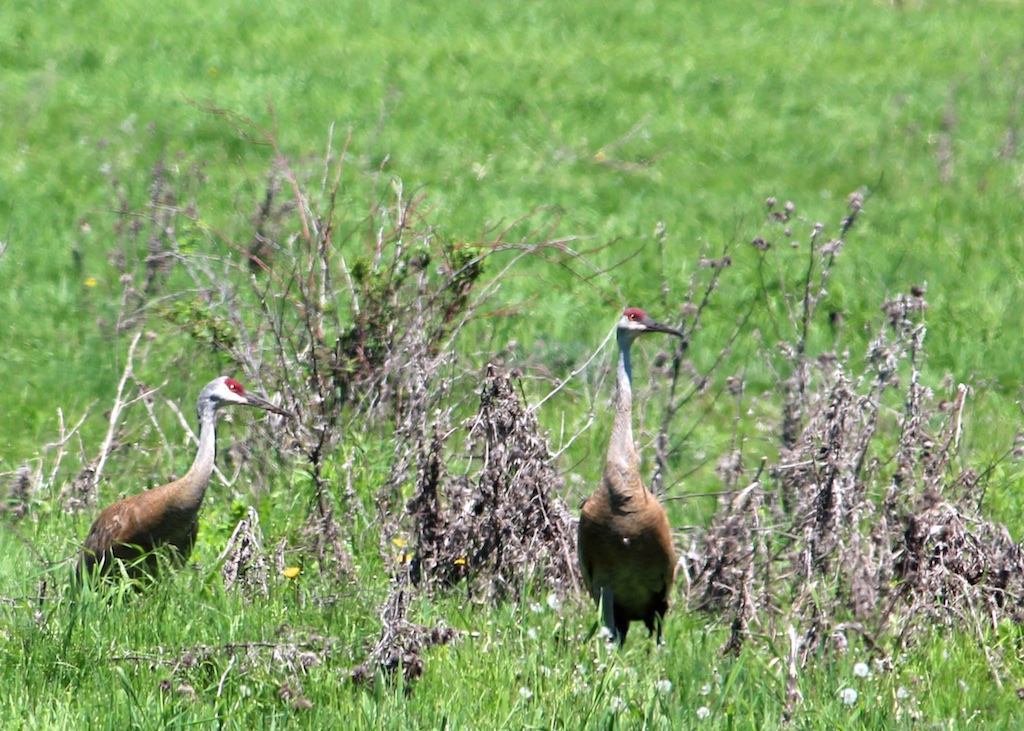
And yet, there are Robins. And the Sandhill cranes are back. Here they are from last summer. (Could it ever actually be this green again?)
A friend has Snow Drops blooming BLOOMING in her yard.

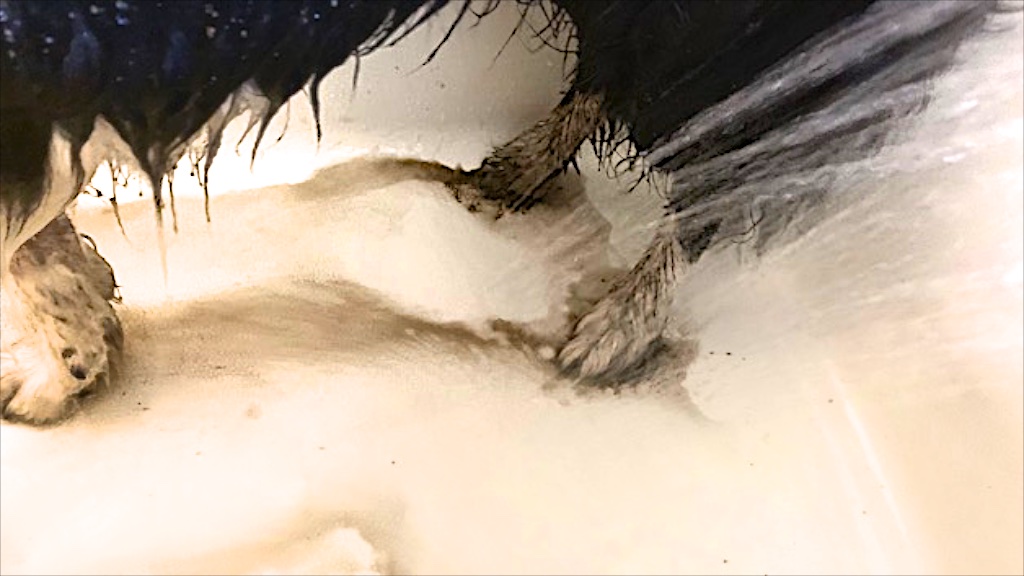
This is what’s blooming at our house. Muddy paws. Lots and lots of muddy paws.
I gotta go walk dogs. The mud is waiting . . .


Post a Comment