
A Note About Notes
 |
 |


Oh dear. I fear that this is going to be one of the “self-help” pieces in which the author begins by talking about how bad she is at doing something (we’ll call it X), and then tells you why it’s so important to do it. It might end with the author seeing the light, as should we all, and is now doing X with consistency and dedication.
Oh, wait, it’s not going to be like that because I can’t say that I’m now doing X with “consistency and dedication”. But I can say I’m a little better at it than I’ve been in the past, and I’m trying to do better. And it does feel good.
Solve for X? In my case it’s making notes about my progress training Maggie to work sheep in a competitive trial context. I do take notes on how things are going, what I learned at a clinic, etc, and always intend to organize them into coherent order from all from the various journals and random pieces of mud-stained paper that they exist on now. However, “coherent order” is a goal I have not yet reached. But, I am making progress, sorting through the notes I’ve taken over the years, and wishing I’d been more organized about it.
I’ve started that process, and here’s what I’ve learned:
Maggie and I have both learned so, so much in the last five years. Reading through my mish mash of notes has reminded me how far we have come. It’s very reinforcing and I highly recommend it. No one is giving us treats or belly rubs for all our hard work, so we need to do it ourselves.
And then, there’s this: It is clear from my notes that Maggie and I both tend to make some of the same mistakes over and over again. “Infinite trial learning” I call it. For example here are some comments from my notes 4 years ago with friend and kick ass sheepdog trainer Peg Anderson, with my grade on how I’ve done since then:
Because Maggie has too much eye (meaning she can get “stuck” on the sheep once she makes eye contact), I should:
– Not stop on the fetch. A+
– Send her toward their tails, not their heads. A-
– When teach driving, keep moving so she learns to like pressure. B-
– Don’t stop her, just work on pace. C+. No, F. No, D. Okay, maybe C-.
About that C minus: It’s easy to say don’t stop your dog, but when things are moving at a million miles an hour and you have to make decisions within less than a third of a second, it’s easier to say than do. Stopping your dog slows things down and gives you a moment to think. But I have worked on not stopping her, and even ran one trial last winter in which my only goal was to run the entire course without stopping her even once. I knew that would mean I might miss a gate and get a lower score, but it was a smart thing to do because we need to practice it in a trial context. All of which I promptly forgot about at the last trial where I lost points for letting the sheep stop, cuz I, uh, kept telling Maggie to lie down cuz things were moving so fast. (See “Review your notes often below”.)
HOW DOES THIS RELATE TO ANY TRAINING? Here are some reasons that I think taking notes are of great value when starting training anything, like new dog, a new set of tricks, or working on a behavior problem.
FIRST, TAKE NOTES After having decided what behavior you want to focus on, take notes. That’s easy to say, but takes some thoughtful organization to do. Job One of note taking is figuring out where to write them. I like to write notes by hand in a notebook, but you you should use whatever you are most likely to use on a regular basis. Try to take your notes in the same place, rather than a random sampling of notebooks and journals (not that I’d know anything about that). Most importantly, make it easy easy easy to make a quick note here and there–if it’s logistically tricky or your expectations don’t match your energy level you’ll stop too soon and lose the value of taking notes.
MAKE NOTES READABLE (This, of course, is purely theoretical.) They don’t have to be pretty, and you can skip all kinds of extraneous words, but what you write needs to make sense a year or two from now. Ahem.
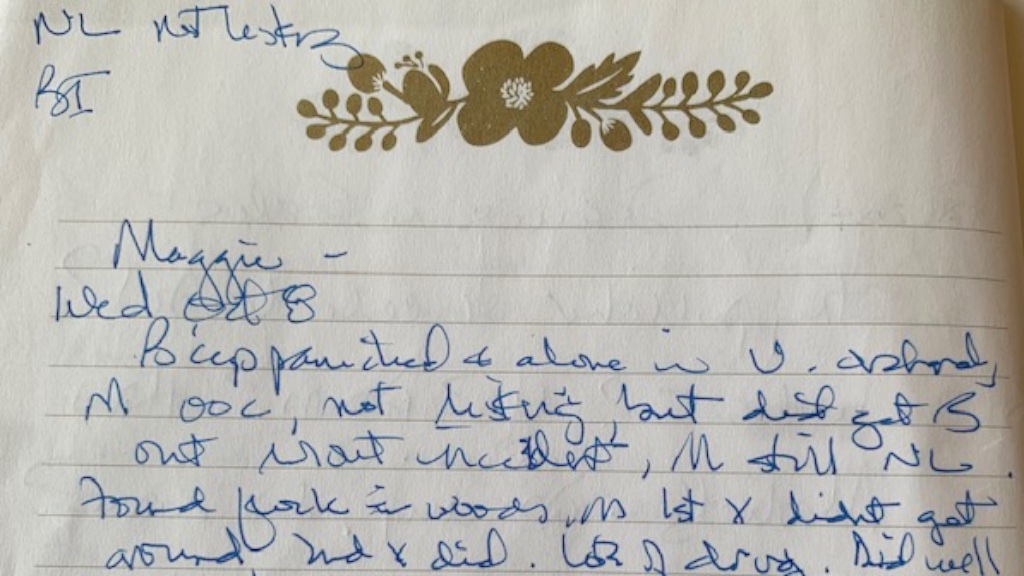
REVIEW YOUR NOTES OFTEN Oh yeah, that part. I found that I remembered many of the things I’d written in my notebooks, but not all of them. And it was easy for me to get distracted by the newest shiny key (teaching Maggie more advanced skills and forgetting about the basics). If I’d review my notes from just a few months ago I no doubt would have done better at the last trial because it would have reminded me to slow things down, rather than stopping them altogether.
I’m going to start a Sunday night ritual in which I update my notes based on the week and review important things I’ve written previously. We rarely go out Sunday night, and that’s usually my Groom the Dogs evening, so I’ll just add that in. Do whatever works for you, but I know I’m not the only one who takes notes and then doesn’t read through them often enough.
YES, IT’S ABOUT YOU TOO As I hope is clear, your notes should be about everything related to your training sessions, including your own behavior. There might be some of us out there whose training skills are perfect. but I’m not one of them. If your training session didn’t go well, exactly what did your dog do instead of what you wanted? What was the context? How did you respond? What can you do to help your dog do better next time?
REINFORCEMENT ISN’T JUST FOR YOUR DOG Our brains are hard wired to focus on the negative, but that’s not helpful here. In my experience dog owners and trainers tend to be pretty hard on themselves, which is not always constructive. I can get sucked into that too, so my notes are full of YAYS! and GREAT!. It’s usually about Maggie’s behavior, but I do try to reinforce myself in my notes too.
WHAT ABOUT YOU? Do you take notes? Any tips or ideas you have for the village about how to take and use them most efficiently? If you’d like to read more, I wrote a blog in November of 2012 on observing and interpreting behavior in which I talk about taking notes too.
MEANWHILE, back on the farm: Just home, again, from a sheepdog trial, except this time Maggie and I weren’t running. I was brought in by the hosts to do some speaking, and what a joy it was. The Vashon Classic Sheepdog Trial is not to be missed for so many reasons. One is that it’s the most spectator-friendly trial I’ve ever attended. There are seats under shady tents, but also this lovely hill where you can stretch out and enjoy the day while watching the drama unfolding out on the field.
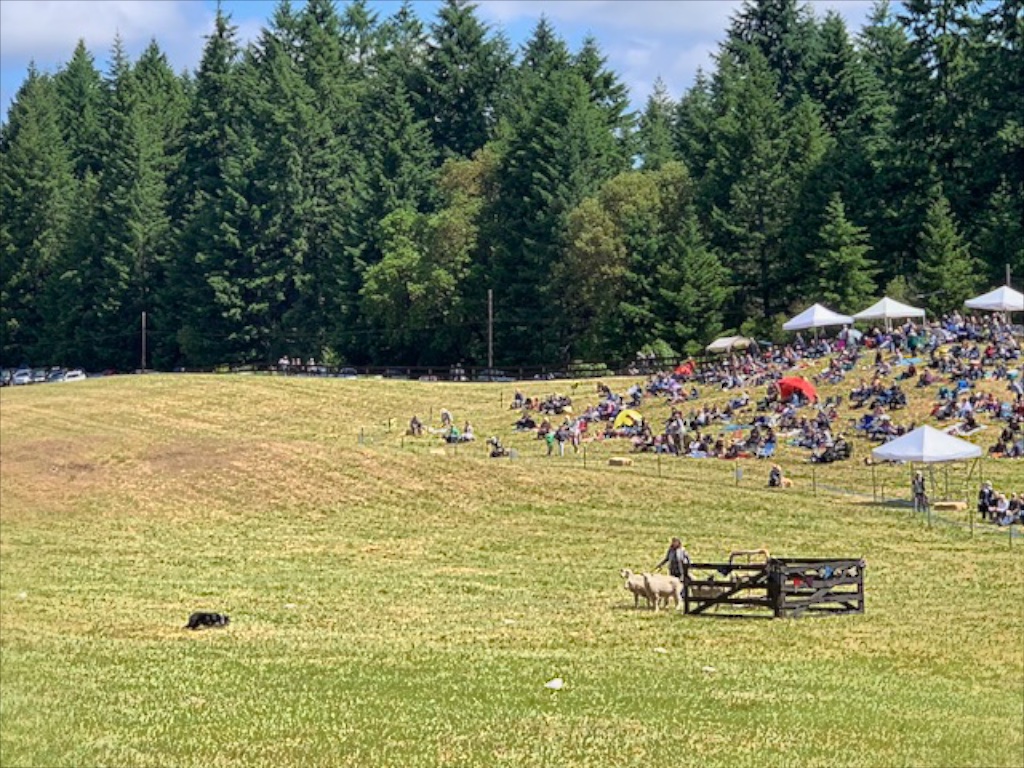
There are fantastic venders, from a Fiber Village where kids can make a variety of fun things with wool, to lots of yummy food, to my buddies from Dogwise, Jon and Jason. Huge thanks to Maggi McClure, Tina Shattuck, and the folks of Vashon for making our time there a joy.

I thought you might enjoy these photos of a shed (anyone know who this is? I apologize for not knowing!), showing some of the stages of the process. The goal is to split two sheep off of the rest. For full points it should be the back two, depending on their line of travel, but you still get some points if it is any two. Any port in a storm sometimes. Here the handlers has got the sheep nicely lined up so that if she and the dog move correctly (inches matter), there will be enough of a gap for her dog to come in and separate the flock.
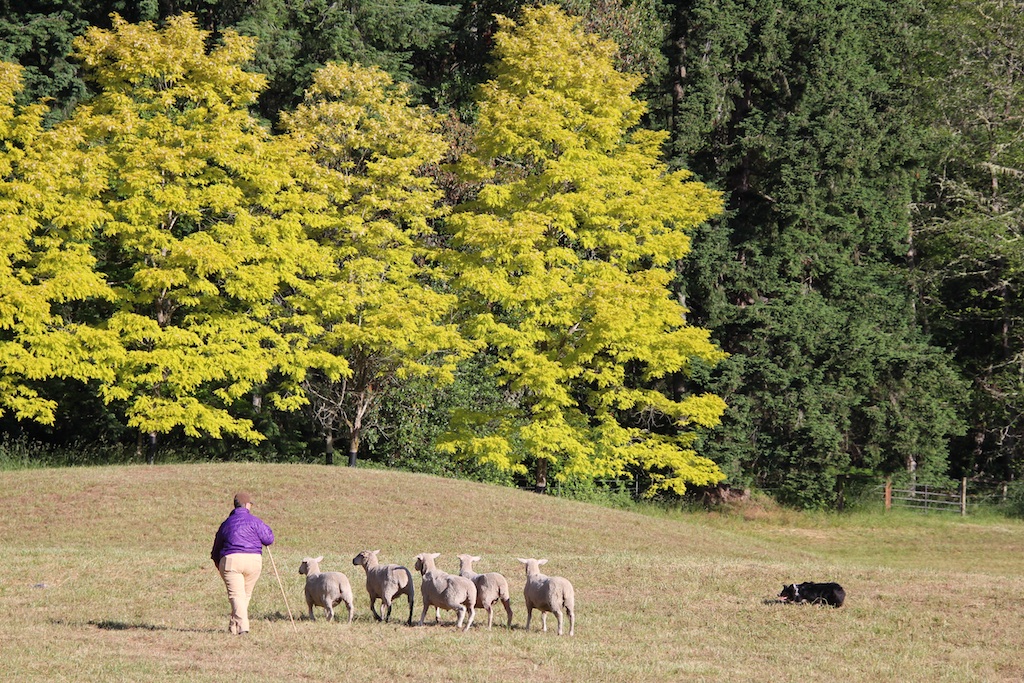
In the photo below you can see her dog in the process of coming in to keep the sheep separated.

The next photo shows catch the moment in which the dog looked at the “wrong group” of sheep–he needs to be driving the two on the left away. However, I’m not so sure he’s wrong here: he could be warning the ewe looking to the left to stay where she is, so

In the photo below you can see that he made the shed and successfully proved to the judge that he had control of the sheep. Well done!

After it was all over it was sweet to be going home, but lovely to fly over the beautiful mountains of Washington.

Thanks to Washington and Vashon Island for such a wonderful time!


Post a Comment